Sunbirds and Struggling Neighbors: South Korea's Winter Migration and the Class Fault Lines It Exposes
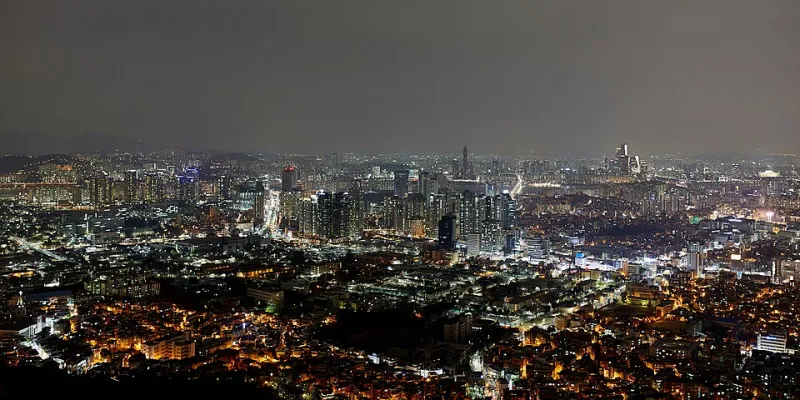
Photo: Mathew Schwartz, CC BY 3.0, via Wikimedia Commons
Sunbirds and Struggling Neighbors: South Korea's Winter Migration and the Class Divide It Exposes
In the weeks between late November and mid-February, the departure terminals at Incheon International Airport fill with a particular kind of traveler. Well-dressed, unhurried, equipped with luggage that suggests extended stays rather than brief holidays — these are Korea's seasonal migrants, the affluent residents of Gangnam and other prosperous districts who have developed a reliable habit of simply leaving winter behind. Their destinations vary: Southeast Asia, the Canary Islands, Florida, the warmer reaches of the American Southwest. What unites them is the financial capacity to treat winter not as something to be endured, but as something to be avoided entirely.
Left behind are the millions of Koreans for whom winter departure is not an option — factory workers in Incheon's industrial corridors, delivery drivers navigating icy streets, elderly residents in poorly insulated rural housing, and the vast informal workforce whose income stops the moment they stop working. For these Koreans, winter is not a season to be curated or escaped. It is a test of survival that the state, critics argue, consistently fails to prepare them for.
The contrast has always existed. What has changed is its political legibility.
The Geography of Departure
South Korea's winter migration follows a geography that mirrors the country's wealth distribution with uncomfortable precision. The heaviest concentrations of long-term winter travelers originate from Seoul's affluent southern districts — Gangnam, Seocho, and Songpa — as well as from the wealthy satellite cities of Bundang and Pangyo, where technology executives and financial professionals cluster. Travel industry data compiled by the Korea Tourism Organization suggests that households in the top income quintile are approximately six times more likely to spend two or more weeks abroad during the December-February period than those in the bottom two quintiles.
The destinations themselves carry class signifiers. Retirees and older wealthy Koreans gravitate toward the Philippines, Thailand, and Vietnam, where the cost of living allows extended stays without depleting savings. Younger affluent professionals favor more aspirational destinations — Japan's ski resorts, European city breaks, and increasingly, extended stays in American cities like Los Angeles and Honolulu, where Korean diaspora communities provide social infrastructure.
For sociologist Dr. Yoon Ji-hye of Yonsei University, who has studied Korean mobility patterns for over a decade, the migration is inseparable from the country's broader stratification crisis. "We often discuss inequality in terms of income statistics or housing prices," she explained in a recent interview. "But seasonal mobility is one of the most visceral expressions of class difference because it is so visible. When your neighbor leaves for three months and you cannot take a single day off, the gap between you is not abstract. It is lived every morning when you check the weather."
Political Temperatures
The electoral consequences of this seasonal divide are becoming harder for Korean politicians to ignore. In the 2022 presidential election, the geographic and demographic patterns of the vote revealed a country fractured along lines that correlate closely with winter mobility. Wealthier urban districts, whose residents have the luxury of disengaging from Korea's physical hardships, trended toward candidates emphasizing deregulation and market-driven solutions. Poorer urban districts and rural constituencies, whose residents face winter's full force without insulation — literal or economic — favored candidates promising expanded welfare infrastructure and heating subsidies.
Rep. Park Sung-min, a progressive lawmaker from a working-class district in Gyeonggi Province, has made the winter mobility gap a recurring theme in his floor speeches. "When we debate the heating allowance or the emergency welfare fund," he said during a November session of the National Assembly, "I want my colleagues to remember that some of us are having this debate while our constituents are rationing coal briquettes. Others are having it while deciding whether to extend their Phuket villa rental by another week. These are not the same country."
Conservative legislators have pushed back against what they characterize as class resentment masquerading as policy analysis. "People who have worked hard and succeeded have every right to spend their money as they choose," argued one senior PPP lawmaker, who requested anonymity to speak candidly. "Turning personal travel choices into a political grievance is a distraction from the real work of building an economy where more Koreans have those choices."
Rural Korea's Frozen Season
If Seoul's wealthy districts empty out in winter, the country's rural provinces fill with a different kind of absence — the absence of services, infrastructure, and political attention. Small towns in North Gyeongsang and South Jeolla provinces, already hollowed out by decades of urbanization, face compounding vulnerabilities during the cold months. Heating infrastructure in older rural housing stock remains chronically inadequate. Local governments, underfunded and understaffed, struggle to deliver the kind of emergency welfare response that urban districts can at least approximate.
Demographer Lee Chang-won of the Korea Research Institute for Human Settlements notes that the political consequences of rural winter hardship are playing out in slow motion. "The people who suffer most from winter in Korea are also the people with the least political voice," he observed. "They are older, more geographically isolated, and increasingly disconnected from the national political conversation. That is a governance failure with long-term electoral consequences — eventually, these communities stop expecting anything from the state at all."
That political disengagement, paradoxically, may benefit the very parties least likely to address rural winter hardship. Voter turnout in the most economically vulnerable rural districts has declined steadily over the past three electoral cycles, a trend that analysts on both sides of the political spectrum acknowledge without fully confronting.
The View From the Departure Lounge
For American observers, South Korea's winter migration pattern may carry a familiar resonance. The seasonal flight of the wealthy from cold-weather hardship — the "snowbird" phenomenon familiar from states like Michigan and New York, where affluent retirees decamp to Florida each winter — is not unique to Korea. What distinguishes the Korean case is the degree to which the gap between those who leave and those who remain maps onto acute political tensions in a country already navigating serious questions about its democratic future.
As Korea heads into another winter season, the departure lounges at Incheon will fill again. The question that sociologists, opposition politicians, and an increasing number of ordinary Korean citizens are beginning to ask is not whether the wealthy have the right to travel. It is whether a society that allows its most vulnerable members to freeze while its most privileged members migrate can sustain the civic solidarity that functional democracy requires.
The cold, as always, has a way of clarifying things.