Drafted Into Winter: How South Korea's Cold Season Became the Crucible of Mandatory Military Service
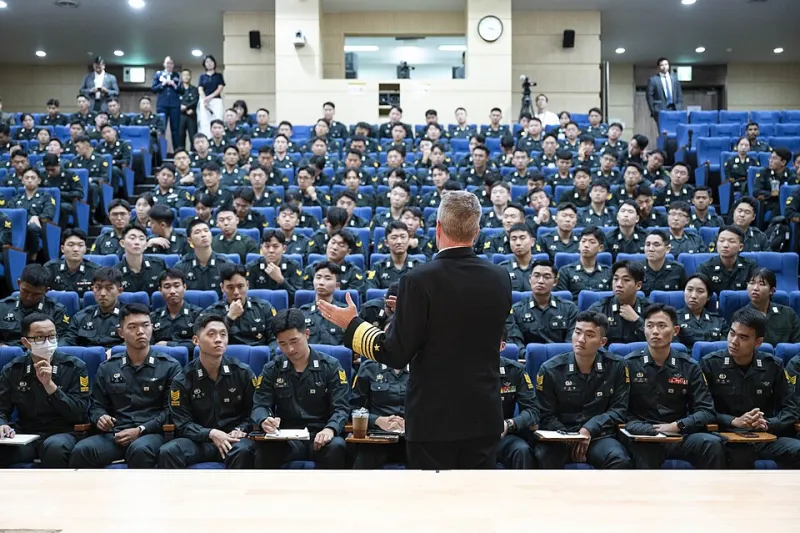
Photo: U.S. Navy photo by Petty Officer 1st Class John Bellino, Public domain, via Wikimedia Commons
Every January, across apartment complexes and university dormitories throughout Seoul, a particular kind of quiet descends. Young men in their early twenties check their phones with a specific anxiety—not for exam results or job offers, but for induction notices from the Military Manpower Administration. South Korea's mandatory military service system, one of the most comprehensive conscription frameworks among democratic nations, has developed an unmistakable seasonal cadence. Winter, it turns out, is when the machinery of national defense most visibly intersects with the lives of ordinary citizens.
For American audiences accustomed to an all-volunteer military, the scale and intimacy of South Korea's conscription apparatus can be difficult to fully grasp. Every able-bodied male South Korean citizen is required to serve approximately eighteen to twenty-one months, depending on branch of service. The system processes hundreds of thousands of young men annually, and while inductions occur throughout the year, the winter months—particularly December through February—carry disproportionate administrative and emotional weight. This is when the Military Manpower Administration typically releases draft lottery results, schedules physical examinations, and processes a significant volume of induction orders for the spring intake cycle.
The Bureaucratic Logic of a Cold-Weather Calendar
The concentration of conscription activity in winter is not accidental. Military officials have long recognized that aligning administrative processing with the academic calendar creates operational efficiencies that would be difficult to replicate in other seasons. South Korean universities follow a semester structure that ends in late December, meaning the largest available cohort of eligible men—recent graduates and those completing academic deferments—becomes administratively accessible precisely when temperatures drop below freezing.
A senior official at the Military Manpower Administration, speaking in general terms about scheduling philosophy, has noted publicly that synchronizing induction cycles with natural social transition points reduces logistical friction. Young men already navigating the end of one chapter of their lives are, in institutional terms, easier to process when they are not simultaneously managing coursework or employment obligations. Winter, in this reading, is not merely a backdrop. It is a structural convenience.
But convenience for administrators translates into something far more complex for the individuals involved. The winter notice arrives at a moment already saturated with reflection—the close of a year, the pressure of family gatherings, the cultural weight of the Lunar New Year approaching on the horizon. For many young Korean men, the conscription letter lands not as a bureaucratic formality but as a psychological event, one whose timing amplifies its emotional resonance in ways that a midsummer notice might not.
Families in the Cold: The Human Architecture of Induction Season
At induction centers across the country, the farewell scenes that play out in January and February have become a recognized feature of South Korean winter. Mothers in heavy coats press food into the hands of sons who are trying to appear composed. Girlfriends and younger siblings stand in parking lots that have not been fully cleared of ice. Fathers, many of whom completed their own service decades earlier, offer handshakes that carry the complicated weight of shared experience and unspoken worry.
The emotional choreography of these moments is not incidental to how the policy functions politically. South Korea has maintained mandatory conscription for over seven decades, and public acceptance of the system—despite its significant costs to individual freedom and career development—depends in part on the rituals that surround it. The winter farewell has become one of those rituals. It gives shape and gravity to a sacrifice that might otherwise feel abstract, embedding it in the sensory memory of cold air, visible breath, and the particular silence of a parking lot after a bus has pulled away.
Families interviewed at induction centers in recent years have described the winter timing as both difficult and, in a strange way, fitting. One mother from Incheon, whose son was inducted in early February, described the season as honest—a word that carries considerable weight in Korean. "Summer would feel wrong," she said. "This is serious. The cold makes it feel serious."
Demographic Anxiety and the Politics of the Draft
Behind the administrative calendars and farewell ceremonies lies a set of political pressures that have grown more acute in recent years. South Korea's birth rate has fallen to historic lows, a demographic crisis that threatens not only the social welfare system but the military's ability to sustain conscription at current levels. Defense planners are already modeling scenarios in which the eligible male cohort shrinks so dramatically that service lengths must be extended or eligibility criteria substantially revised.
Winter, as the season when conscription data is most publicly visible, has become the annual moment when these demographic anxieties surface most clearly in political discourse. Opposition lawmakers regularly use the January induction cycle as an occasion to challenge the government's long-term military readiness projections. Progressive voices raise questions about whether the burden of service is equitably distributed across socioeconomic lines—a debate with obvious parallels to American discussions about the Vietnam-era draft and its class disparities.
The government, for its part, has used winter announcements strategically. Policy reforms—adjustments to service length, expansions of alternative service options for conscientious objectors, changes to the physical fitness criteria—are frequently timed for release in December or January, when public attention to military matters is already elevated. The cold season, in this sense, provides political cover as much as administrative convenience. Difficult news lands more softly when it arrives alongside a ritual that the public has already internalized as inherently serious.
What America Might Learn From Seoul's Seasonal Playbook
The United States has not operated a mandatory draft since 1973, and the prospect of reinstating conscription remains politically toxic across most of the ideological spectrum. Yet the question of how governments manage the public acceptance of unpopular but necessary policies is perennially relevant, and South Korea's experience offers some instructive lessons.
First, timing matters in ways that extend beyond mere logistics. The South Korean system's alignment of conscription administration with winter—a season already associated in the public mind with endings, reflection, and transition—demonstrates that the emotional context in which a policy is experienced shapes how it is received. American policymakers designing the rollout of unpopular measures, from tax increases to benefit reforms, might consider more carefully the seasonal and cultural environments into which those announcements land.
Second, ritual provides political durability. The farewell ceremonies at South Korean induction centers are not officially scripted, yet they have become a stable feature of national life precisely because they give citizens a way to process a difficult obligation collectively. Policies that lack such ritualizing frameworks tend to generate more sustained resentment.
Third, transparency about demographic strain can be a political asset rather than a liability. South Korea's willingness to publicly acknowledge that its conscription system faces structural pressure from falling birth rates has, somewhat paradoxically, increased public engagement with the policy rather than undermining confidence in it. Americans watching their own institutions struggle with demographic and fiscal pressures might find that honesty, delivered in the right season and the right register, lands better than officials typically assume.
The Weight of Winter
For the young men boarding buses at induction centers this January, the philosophical dimensions of their country's conscription calendar are probably not foremost in their minds. They are thinking about the cold, about the people they are leaving behind, about what eighteen months of regimented life will feel like after the relative freedom of university. But the system that has placed them on those buses at this particular time of year has been calibrated, over decades, to make their departure feel like part of something larger than themselves.
That calibration is, in its way, a remarkable political achievement. Whether it is also a just one remains, as it has always been, an open question—one that South Korea's winter, with its characteristic combination of clarity and harshness, refuses to let anyone answer too easily.